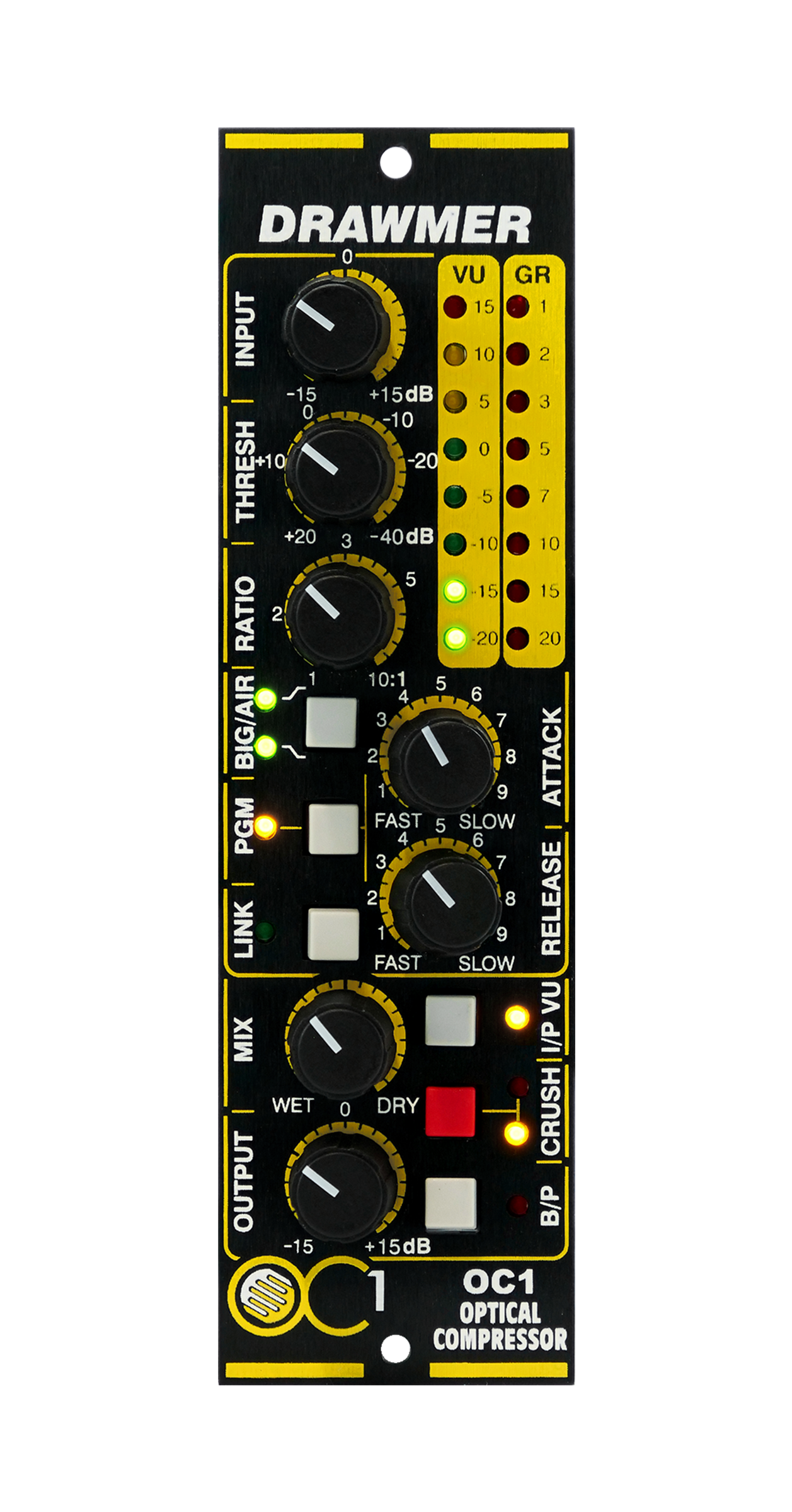
The OC1 offers Optical compression, ideal for adding smooth, warm and natural-sounding dynamic control across all audio sources, but is particularly good for vocals and acoustic guitars.
Total Control
Uncommon in 500 series compressors, the OC1 offers a full complement of features. Input/Output gain, all the familiar Threshold, Ratio, Attack, and Release controls, as well as parallel compression capabilities with the Wet/Dry Mix knob - all fully adjustable, and recallable through the 21-position detented high precision pots - allowing total control of dynamics.
BIG and AIR Modes
A high-end feature taken from the award winning 1973 multi-band studio compressor, the fully selectable BIG and AIR modes shape how the compressor responds to low and high frequencies, adding extra richness and warmth on the lows, and more sparkle and brightness on the highs.
BIG reduces the side chain's sensitivity to low frequencies, creating the effect that the bass is louder or bigger. It also has the benefit of reducing the ducking and pumping effect that occurs due to highs being ‘pulled down’ by low-frequency dominance, helping to make mix compression much more affable.
AIR preserves high-frequency detail that is sometimes lost in the compression process. The result being that the treble sounds more intimate, detailed and transparent, but without making it sound harsh or introducing any noticeably unnatural artefacts, adding definition, particularly to the human voice and acoustic instruments. Cymbals appear more vibrant without becoming splashy, and vocals sound more open but without becoming sibilant.
CRUSH Saturation
The OC1 also includes the popular CRUSH harmonic feature. The effect varies with the level of input gain, and adds harmonic richness, subtle distortion, and that elusive analogue warmth that brings mixes to life. The low end fattens, the mids gain presence, and the top end sparkles with smooth shimmer.
A PGM mode switch introduces a second, slower release time in proportion to the program material above the threshold. The effect is to reduce excessive 'pumping' and unnatural artifacts under heavy compression.
Stereo Linking
Using the dedicated Link pin 6 on the 500 chassis, the Gain Reduction of compressor modules placed in adjacent slots can be linked together using the LINK button. This feature is ideal for linking multiple channel modules. The module requiring the highest gain reduction is master and trigger for all the other linked modules. The link feature includes the Big and Air, Threshold and Ratio controls.
Output Gain control allows the compressed signal to be adjusted and comprehensive metering shows Gain Reduction, and a choice of Input or Output level on the VU meter. To complete the feature set, a hard-wire unit Bypass connects the input directly to the output without alteration.
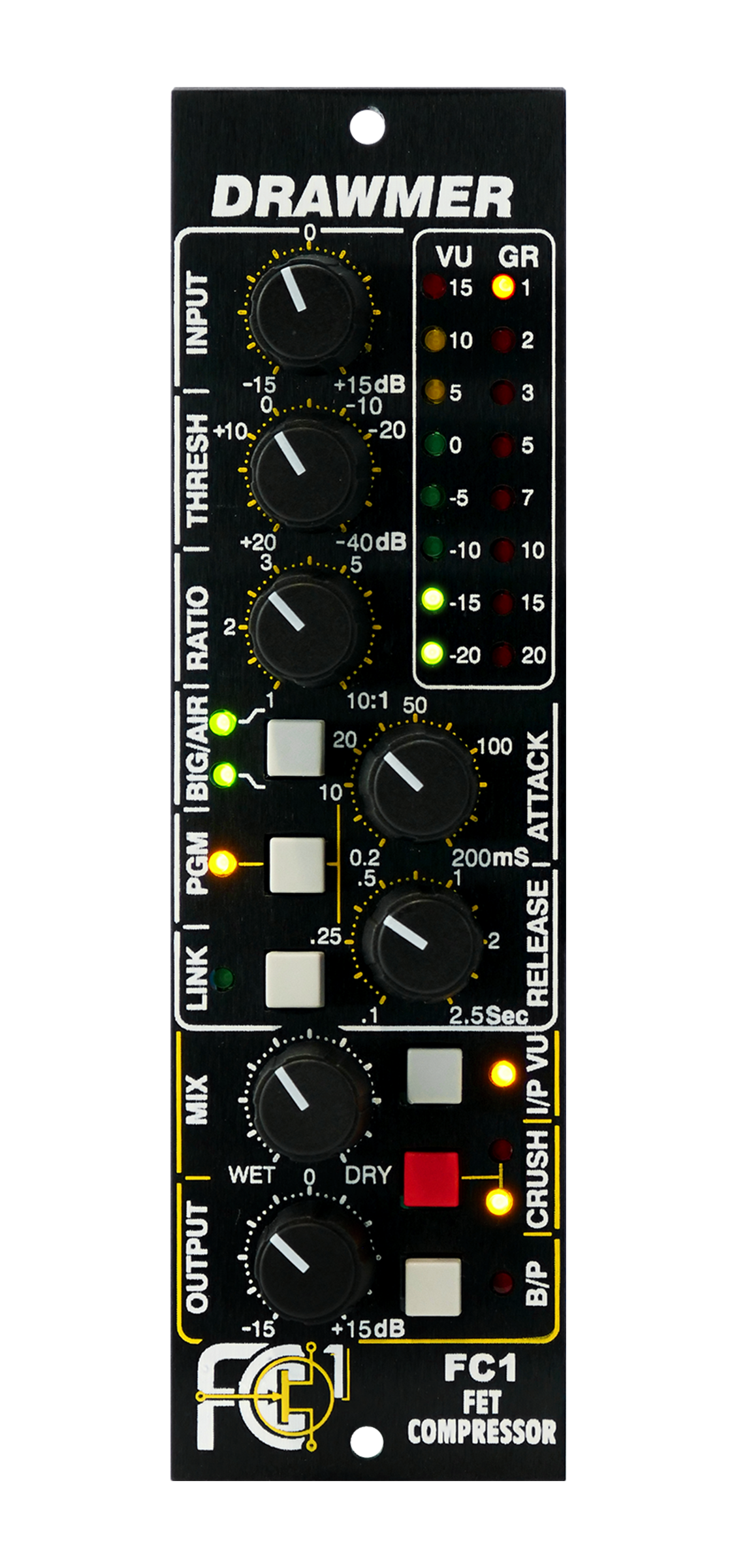
The FC1 brings Drawmer compression to the 500 series format. Featuring a complete control set and advanced shaping tools, this unit offers the precision, flexibility, and character typically found in a full Drawmer rack-mount unit, fitting into a single 500 series slot. The FC1 is a FET compressor, ideal for adding punchy compression due to its fast attack and release times.
Total Control
Uncommon in 500 series compressors, the FC1 offers a full complement of features. Input/Output gain, all the familiar Threshold, Ratio, Attack, and Release controls, as well as parallel compression capabilities with the Wet/Dry Mix knob - all fully adjustable, and recallable through the 21-position detented high precision pots - allowing total control of dynamics.
BIG and AIR Modes
A high-end feature taken from the award winning 1973 multi-band studio compressor, the fully selectable BIG and AIR modes shape how the compressor responds to low and high frequencies, adding extra richness and warmth on the lows, and more sparkle and brightness on the highs.
BIG reduces the side chain's sensitivity to low frequencies, creating the effect that the bass is louder or bigger. It also has the benefit of reducing the ducking and pumping effect that occurs due to highs being ‘pulled down’ by low-frequency dominance, helping to make mix compression much more affable.
AIR preserves high-frequency detail that is sometimes lost in the compression process. The result being that the treble sounds more intimate, detailed and transparent, but without making it sound harsh or introducing any noticeably unnatural artefacts, adding definition, particularly to the human voice and acoustic instruments. Cymbals appear more vibrant without becoming splashy, and vocals sound more open but without becoming sibilant.
CRUSH Saturation
The FC1 also includes the popular CRUSH harmonic feature. The effect varies with the level of input gain, and adds harmonic richness, subtle distortion, and that elusive analogue warmth that brings mixes to life. The low end fattens, the mids gain presence, and the top end sparkles with smooth shimmer.
A PGM mode switch introduces a second, slower release time in proportion to the program material above the threshold. The effect is to reduce excessive 'pumping' and unnatural artifacts under heavy compression.
Stereo Linking
Using the dedicated Link pin 6 on the 500 chassis, the Gain Reduction of compressor modules placed in adjacent slots can be linked together using the LINK button. This feature is ideal for linking multiple channel modules. The module requiring the highest gain reduction is master and trigger for all the other linked modules. The link feature includes the Big and Air, Threshold and Ratio controls.
Output Gain control allows the compressed signal to be adjusted and comprehensive metering shows Gain Reduction, and a choice of Input or Output level on the VU meter. To complete the feature set, a hard-wire unit Bypass connects the input directly to the output without alteration.
The D-Clock is a dual input/twenty output word clock distributor with a 16 character blue LCD display providing a reference measurement of the incoming sample rate. Both AES/EBU and BNC word clock inputs feature a zero latency loopthrough output with switchable high impedance to maintain the correct level of the digital signal for onward distribution. The D-Clock displays incoming sample frequencies up to 768 kHz to an accuracy of 2ppm (parts per million) with two further modes - sample frequency with ±ppm error and sample frequency with % pull up/down for video users.
Sixteen BNC clock outputs are situated on the rear panel with a further four BNC clock outputs on the front panel for quick patching to other digital devices. The word clock outputs can be derived from either a word clock input or alternatively an AES/EBU audio signal from which clock information can be stripped. In the latter case, one of the many mic pre's with internal A/D conversion but no word clock output can be utilised as the master clock source for the whole digital studio.
The MXPRO-60 Front End One is a unique mic/line/instrument input channel in a single rack space providing high quality Drawmer processing prior to tape/hard disc recording. The MXPRO-60 is also ideally suited to project studio and live sound applications. Functioning as a studio grade mic pre-amp, Program Adaptive™ gate, de-esser, compressor, limiter, three band EQ and multi band tube saturation stage, the MXPRO-60 offers the user more options than competitive units currently available.
Grass Roots - The MXPRO-60 draws its technology from the most successful of Drawmer products. The mic pre-amp features the same discrete component design found in the legendary Drawmer 1960, the de-esser is derived from the MXPRO-50, the VCA based compressor is similar to the MXPRO-30, while the peak limiter and gate can be tracked back to the DL241 compressor/limiter.
The LA12 is a low noise, low crosstalk distribution amplifier with high bandwidth specification, developed specifically for 'real time' cassette duplication. As more and more facilities invest in this form of tape copying, the LA12 offers the efficient solution to interfacing multiples of 'real time' cassette decks.
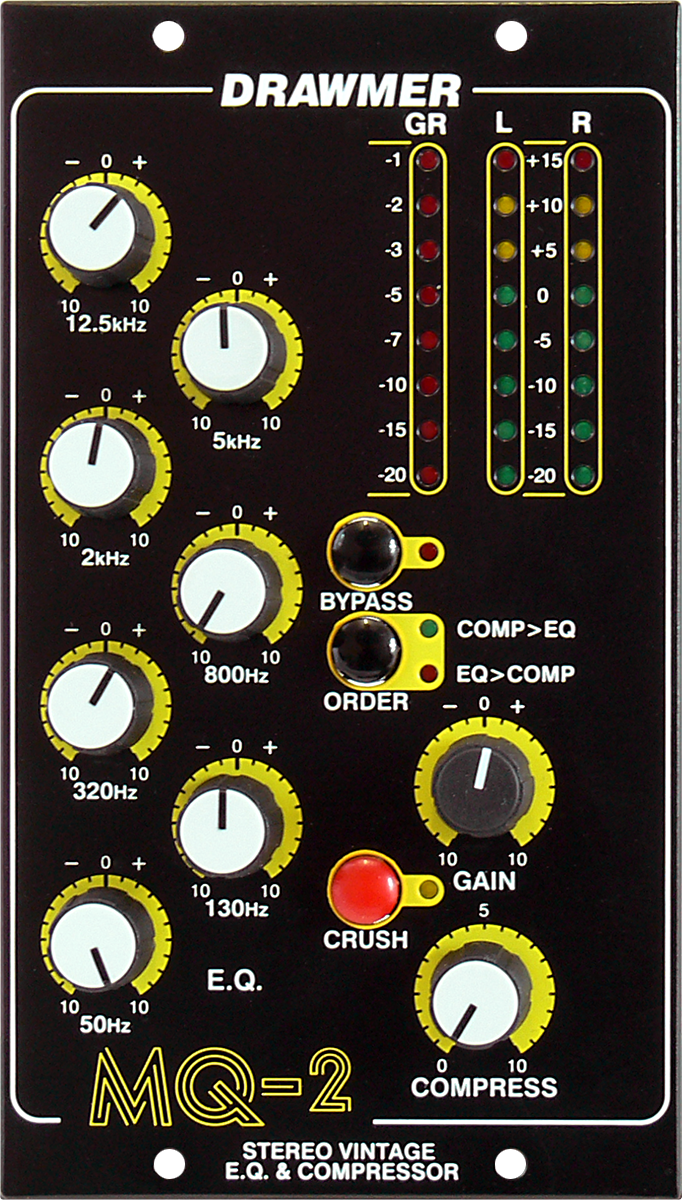
Taking inspiration from the legendary ‘Motown EQ’, the MQ-2 is a stereo, 7 band proportional Q Equaliser with EQ curves akin to the renowned EQ’s used in the illustrious Detroit studios in the 1960’s. This 100% analogue EQ features 7 bell curves, each having a variable cut/boost of ±10dB and set at the beautifully musical frequencies of the original.
However, the MQ-2 is not only an EQ, it also incorporates a programme dependant, effortless to use one knob compressor that adapts its envelope to the characteristics of the signal.
But it doesn’t stop there. In addition, it incorporates the highly regarded ‘CRUSH’ feature present on the Drawmer 1971. When you activate the crush circuit, get ready for some pleasing harmonic saturation and that classic analogue warmth that adds a ton of character to any signal passing through the unit. The result? It fattens up the bass, adds presence to the mids, and brings a delightful shimmer to the top end. The harder you drive the EQ and compressor the more Crush you’ll get.
Using single controls for both channels it has never been easier to get the classic warm analogue sound you’ve been looking for.
The distribution of mono and stereo balanced audio signals from a single source to multiple destinations has many applications including multi-zone sound reinforcement installations, live sports events coverage, broadcast studios, video suites, duplication or indeed anywhere high quality audio has to be distributed to a number of locations down long cable runs.
The Drawmer DA-6 is a six channel stereo (or twelve channel mono) distribution amplifier featuring XLR balanced inputs and outputs with optional transformer balancing where remote amplifiers and recorders are fed from separate power supplies.
The stereo Input features individual left/right level controls with LED bargraph metering enabling the correct balancing of stereo material or two mono signals. Each of the six outputs incorporate further left/right level controls and a Mono/Stereo switch providing the selection of either one stereo output or two mono outputs per channel. This feature allows the DA-6 to function as either a 1 x stereo input/6 x stereo outputs or 2 x mono input/12 x mono output unit or any combination of the two.
The output section consists of a Channel Select so that the individual left/right output level of each channel is displayed on the output LED bargraph and can be monitored by the Headphone jack socket. A pair of auxiliary link stereo jack sockets (TRS) are provided via the rear panel for connection to further DA-6 units for the distribution of even more channels.
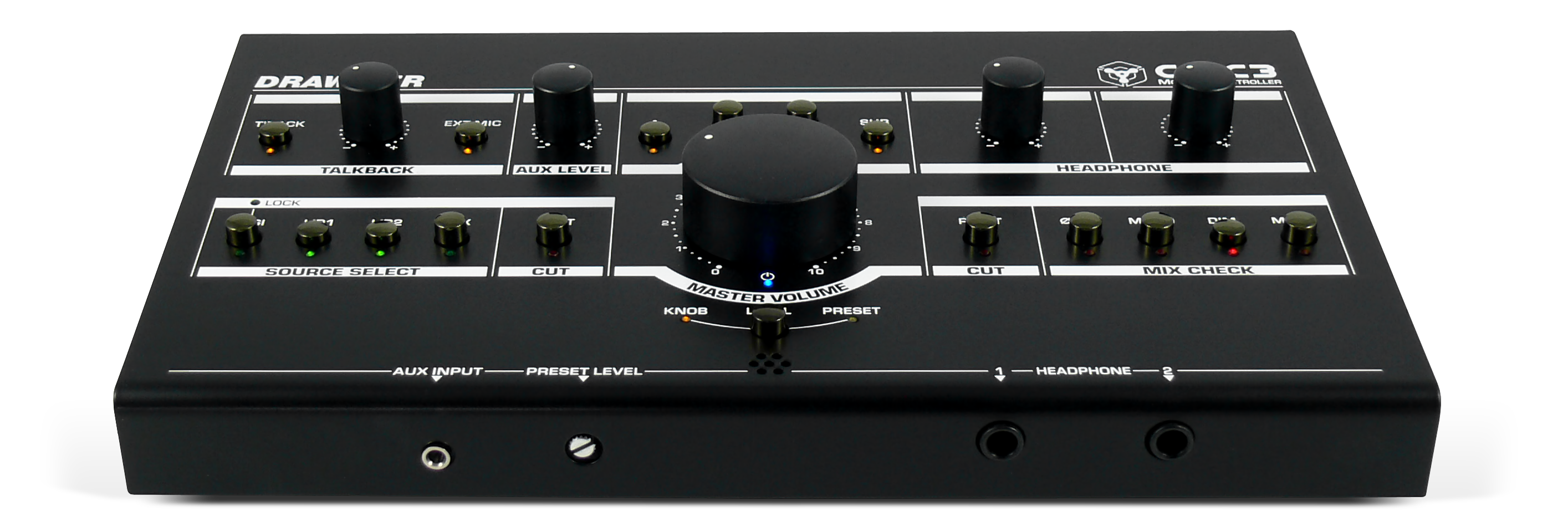
The CMC3 Compact Monitor Controller consolidates the feature sets of Drawmer's 3 most popular monitor controllers: Whilst retaining the famed accurate, and transparent audio quality of the MC2.1, it has the precision and control of the MC3.1 and the low profile, compact design of the CMC2. It is equally at home in a serious home studio as in a professional recording facility.
There is one thing that should always be absolutely guaranteed - that you can rely on the accuracy of your monitor controller. Drawmer monitor controllers do not flavour, colour, warm, improve or brighten the signal, the active circuit has been designed to faithfully produce the audio signal whilst removing many of the problems that a passive circuit will bring. For all Drawmer monitor controllers it is imperative that what you record is exactly what you hear.
Accurate & Transparent
With the same Drawmer pedigree as the MC2.1, the CMC3 circuit is just as transparent and accurate. It has been designed to remove the limitations that a passive circuit brings, such as the ability to increase the volume for quiet passages and improved mix checking, without adding the artifacts that lesser quality active circuits introduce.
Precision
The CMC3 supports 3 sets of stereo monitors, plus a dedicated mono speaker/sub-woofer output, each can be switched individually and simultaneously and in any order, especially useful for A/B comparisons. The sub-woofer can be used with multiple speakers, or turned off altogether.
The volume control utilizes a parallelled custom quad pot for excellent channel matching and smooth feel, as does the secondary preset volume control on the front. This provides repeatable calibrated output level for the monitors, so that at the flick of a switch the engineer can hear the mix at the same predetermined volume, time after time, without having to meticulously adjust controls.
Multiple Connections
The CMC3 is very well connected with 4 stereo inputs in total: 1x SPDIF digital input (24 bit/192kHz), using the same DAC chipset as the established MC3.1 monitor controller, 2 stereo balanced jack inputs, plus a 3.5mm jack with variable level control for Smartphones/MP3 Players.
In addition, it has a 2 professional quality headphone outputs with a separate amplifier and level control, that provide the same audio quality and mix checking as the CMC3 does through the speakers. Talkback is also included with internal or external microphone, level control and audio routing to a dedicated mono output jack & headphones.
Advanced Mix Checking
The comprehensive mix checking facilities of the CMC3 include dim, mono, phase reverse, left and right cut as well as an easy access mute switch, allowing to check the quality of recordings: tune into the mix to hear any unwanted artefacts, test the effectiveness of the stereo mix, check for phase cancellation, listen to the stereo difference. Features that many monitor controllers lack.
Compact
The CMC3 packs a lot of features into a small unit. The whole package is presented in a very low profile desktop enclosure of just 3.5 cm high with a footprint of 27 x 16 cm.
Tough & Secure
Whilst being smart and stylish the rugged, all steel enclosure will withstand the knocks and bumps of the studio, and, coupled with the high quality components used, the CMC3 is built to last. In addition, a Kensington security slot provides protection from thieves.
The 1976 3 band stereo saturation and width processor has been designed to inject character, colour & life into your recordings and live sound in a style endemic of the classic equipment of the 1970's. The completely analogue saturation of the 1976 will provide the realism that plug-ins can only aspire to, replacing the harsh, sterile digital sound with fullness, softness and warmth. Why emulate saturation when you can have the real thing?
Inspired by the highly acclaimed saturation and width features of our DC2476 Digital Mastering Processor the 3 bands of independent saturation of the 1976 have been designed to add the pleasing imperfections that are so endemic in classic gear. Saturation is ideal for adding fullness to your music, taking your music from a cold, bleak landscape to a warm, bright vista.
In addition, however, unlike conventional saturation products the 1976 also features 3 bands of stereo width control to really bring out the depth and add real presence to your mix, and all with a single, yet comprehensive set of controls that provide genuine stereo operation.
Saturation in music production is something that can really enrich the sound in mixes by adding a subtle form of distortion that adds pleasant-sounding harmonics and character to the music. The 1976 allows you to add this character in a completely analogue, natural way. With 3 bands of independent saturation the 1976 can pull off amazing feats that single-band saturation could never accomplish.
Without stereo widening the mix won't jump out of the speaker and grab your listener, this is where the 3 bands of the 1976 can be used to enhance the extra dimension to take the mix from a flat wall of sound to a 3D immersive experience. The 1976 makes it super easy to control the width with just the single stereo controls of the low, mid and high bands. The benefit of having independent width control for each of the bands is to allow the high frequencies to be spread across a wider soundstage without affecting the low frequency end.
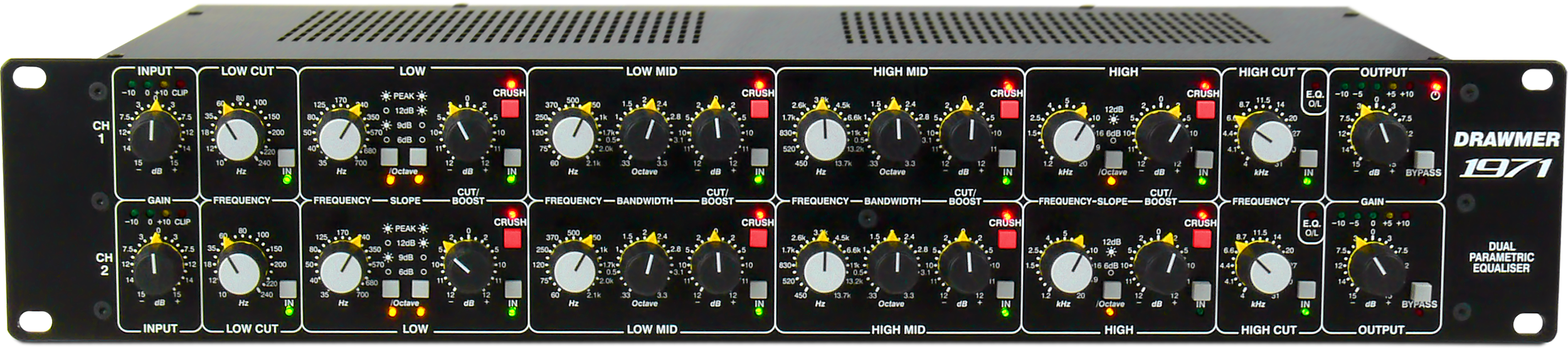
The 1971 offers 2 channels of fully featured 4-band parametric EQ. It has the ability to perform subtle shaping for mastering purposes that require a delicate touch and easy recall, but is just as capable of tonal sculpting, adding the analogue warmth and character that is near impossible to emulate in the digital domain. The versatile design features dual channel precision stepped potentiometers, providing exceptional accuracy for fast and simple recall.
Fully Parametric with Totally Variable Bandwidth.
The 1971 is a true ‘parametric’ equaliser, with the four bands having fully variable frequency controls and offer cut and boost of +/-12dB’s. However, unlike EQ’s with a no bandwidth adjustment, or a simple switch, the two mid bands have completely variable filter bandwidth controls enabling the user to focus in on very narrow sections of the audio spectrum or apply a broad natural sounding filter, or, of course, anything in between the two. This makes the 1971 incredibly versatile and capable of modifying everything from subtly fine tuning mixes to tone sculpting problematic recordings.
Variable Low and High Cut Filters.
The 1971 includes fully variable low and high cut filters (10Hz-225Hz and 4kHz-32kHz respectively), ideal for tuning out undesirable signals. The beauty of being fully variable is that, unlike fixed frequency filters, it is easy to sweep both controls to find the perfect setting and remove sounds with pinpoint accuracy. This is especially useful when bracketing individual tracks.
Switchable Slope Setting.
Very few analogue parametric equalisers have an adjustable slope on the low and high band filters, and is yet another feature of the 1971 that allows you to take control of your audio. The filter slopes of the 1971 have been chosen for their musicality - allowing you to adjust the focus of the audio at the bottom and top ends of your recording but not so harsh as to be a very noticeable brick wall filter. At the bottom end filter slopes of 6, 9 and 12dB per octave plus a Peak setting are available, and at the high end 6 and 12dB’s per octave.
The Peak setting adds a narrow bell shape to the 12dB per octave low band filter at the knee frequency just before it rolls off. Especially useful on kick drums, it magnifies and gives extra weight to the hit whilst still filtering out any subsonic junk and without muddying the lower mid. It’ll give your kick an added sense of power and precision.
Crush
A feature that is unique to the 1971 is the CRUSH button. A switchable option available on each band, it adds a fixed time constant, auto gain makeup compressor, whilst also giving a wider rounder bandwidth. In addition it introduces some musically pleasing harmonics.
The effectiveness of the Crush button will vary depending on the frequency band that it is used in and also on the instrument that it is applied to. Use it in the lower frequencies to fattten up the kick, tom or snare drums, bass guitar and other elements of the rhythm section. In the mid frequencies it will help to warm the mix and enhance the presence. It will thicken the guitars and add punch to the percussion, increase the attack of a piano, as well as help to bring out the raspiness in a vocal, for example. At the high frequencies it will bring out the shimmer of cymbals and brighten the string instruments.
The effect is progressive, so as more boost is added to the band the CRUSH effect is more apparent. Use the switch to listen to A/B comparisons to hear the effectiveness of the feature.
There is little doubt in the minds of many engineers and producers that vacuum tubes possess a unique sound quality providing a "warmer, more alive" sound. Combining eight active tube stages and the low noise and reliability of solid state electronics, the Drawmer 1960 provides the ultimate direct interface between the sound source and the recording medium.
The Drawmer 1960 is a two channel unit with each channel comprised of a completely natural sounding "soft knee" vacuum tube compressor and an extremely low noise microphone pre-amplifier with switchable 48 volt phantom power. A further auxiliary instrument pre-amp with EQ is also provided.
This powerful combination of the classic valve circuit, offering unsurpassed tonality, and the low noise balanced microphone input with up to 60dB of gain has allowed engineers throughout the world to exploit the full potential of high performance condenser microphones. An example of this would be the direct to digital stereo recording of live classical music without the necessity of a mixing console.
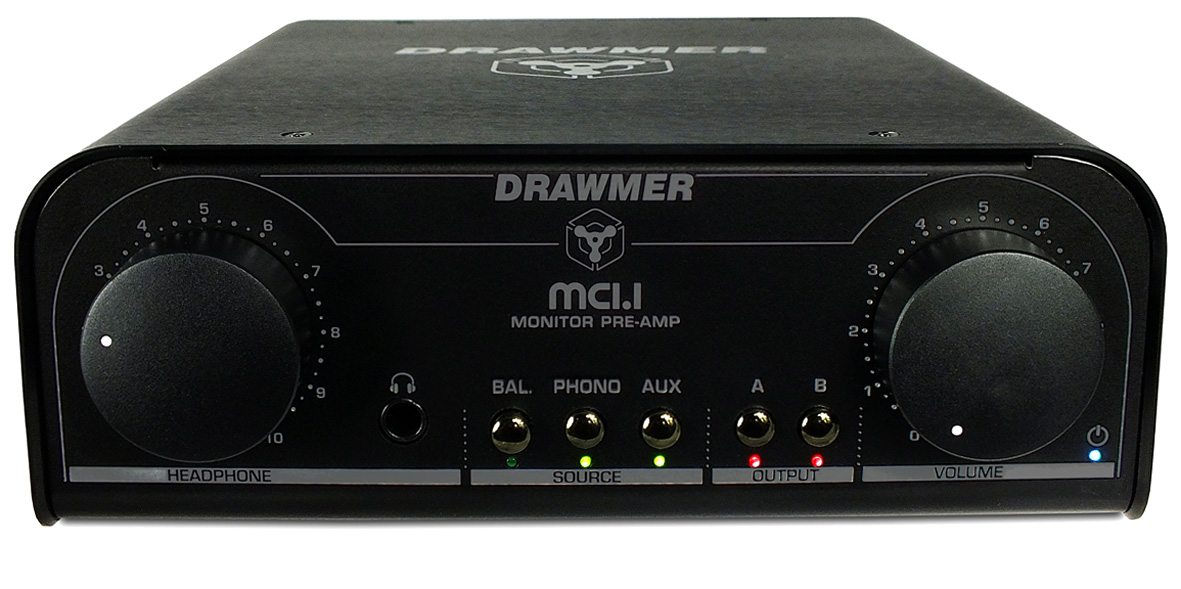
The Drawmer MC1.1 is a Monitor Pre-Amplifier width the same fantastic transparent and non-colouring sound like the well known MC2.1. MC1.1 has a a revised feature set more suitable for a less complex post production booth or home use where multiple speaker setups are not permissible or even required, and with the addition of a new RIAA phono stage the MC1.1 is a great solution for a precious turntable setup.
The front panel is dominated by the two large, independent volume controls for the main line outs and the headphone amplifier, both incorporate a paralleled custom quad pot for excellent channel matching and the smoothest possible action. There are also individual switches for each input source and output section making an elegantly simple yet functional user interface. In addition to balanced XLR inputs of MC1.1 includes an input for MP3 player, iPod or smartphone and a line / phone input for turntables or CD players.
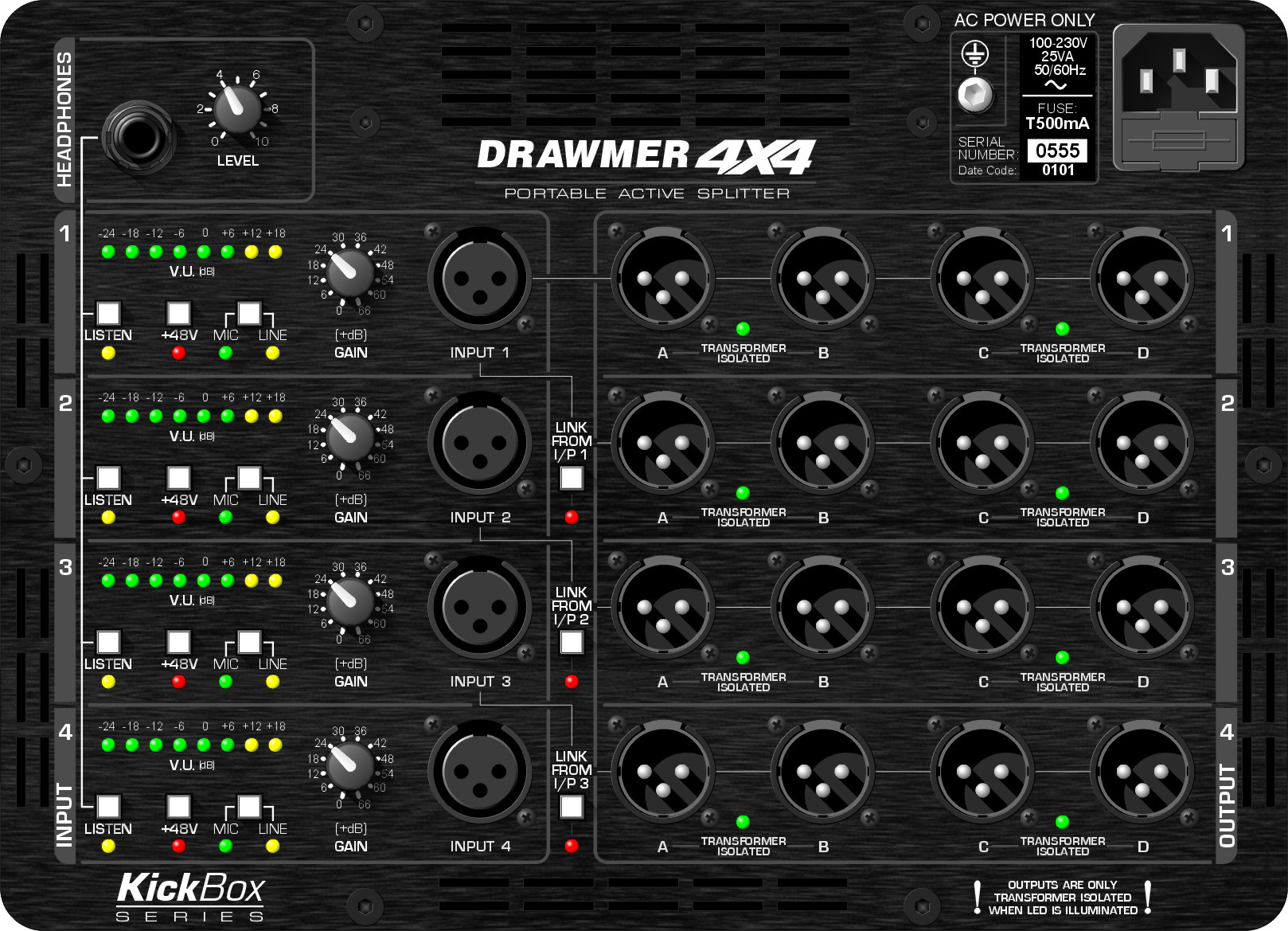
The Kickbox 4x4 is an ‘all terrain' 4 in/16 out mic/line signal splitter. Its extremely high audio quality, robust build and portability make it the ideal tool to provide multiple outputs for live sound, broadcast coverage, sports events, live recording, press conferences, corporate events and any situation where distribution of high quality audio is required. It incorporates 4 studio grade mic/line pre-amps, each providing up to 66dB of gain and 16 balanced output stages, each with the option of transformer isolation and comprehensive linking facilities.
The 4x4 is supplied as standard in a road proof case with a removable lid for unhindered access to all controls and connections.
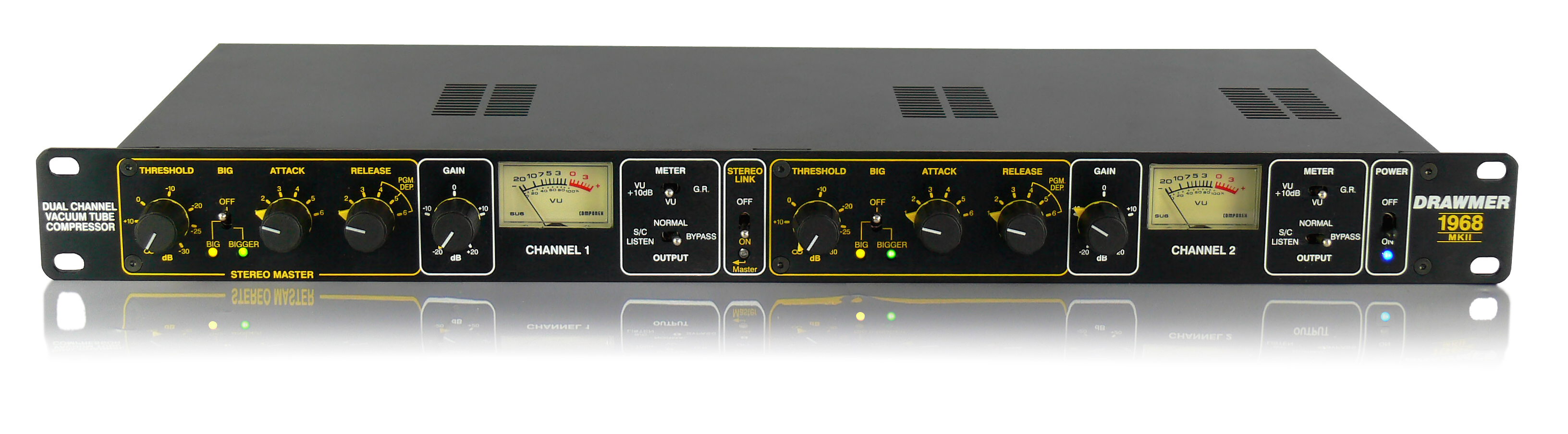
The 1968 is a 1U Tube/FET ‘stereo bus’ compressor which by design delivers a transparent ‘open’ sound even during periods of heavy compression.
Featured on both channels is a switchable 'BIG' mode which now provides a choice of 2 settings: BIG and BIGGER. The BIG setting applies less processing to the low frequencies, reducing the ducking effect caused by bass energy and effectively boosting the bass output, the BIGGER setting even more so. The result - a solid bottom end with enhanced sub-bass and a smoother, wider frequency response overall.
The 1968 is a ‘stripped down’ version of the 1969 introduced to the market by customer demand for those not requiring the instrument and mic preamps incorporated in the 2U 1969.
DESIGNED FOR LIVE & BROADCAST ENVIRONMENTS
Expanding on the renowned D-Clock in providing word clock measurement and distribution, the D-Clock-R has been developed with not only studio recording in mind but also the live and broadcast environment, where reliability and stability are absolutely imperative.
Designed for fail-safe operation the D-Clock-R incorporates dual redundancy for both the power supplies and also the auto-sensing clock inputs, ensuring that the show will go on regardless of technical difficulties.
The D-Clock-R is fitted with two identical and independent power supply units, providing Dual Redundancy. In situations where it is critical that power must be maintained the load is shared between the two supplies, however, should power to one fail the D-Clock-R will still run perfectly well on either.
A 16 character blue LCD display provides a reference measurement of the incoming sample rate to an accuracy of 2ppm and displays the information in three different formats: actual frequency (to one decimal place), nominal frequency +/-ppm error, or nominal frequency plus percentage of pull up or pull down.
Two inputs are provided, a default and auxiliary, capable of locking on to both word clock and AES-3id, with the source automatically selected depending on the type and quality of the signal. Twelve BNC clock outputs are situated on the rear panel with a further four on the front panel for quick patching to other digital devices.
The MXPRO-30 Gate/Comp/Limiter is a low cost professional quality dynamics processor containing some of the proprietary design circuitry used in the more expensive models in the Drawmer range. The MXPRO-30 has many automated features enabling fast, effective dynamic control whilst retaining the instinctively laid out control parameters, sonic character and high technical specification which have made Drawmer the industry standard. The MXPRO-30's competitive price point brings Drawmer's professional processing into a much wider musician, project studio and live performance area.
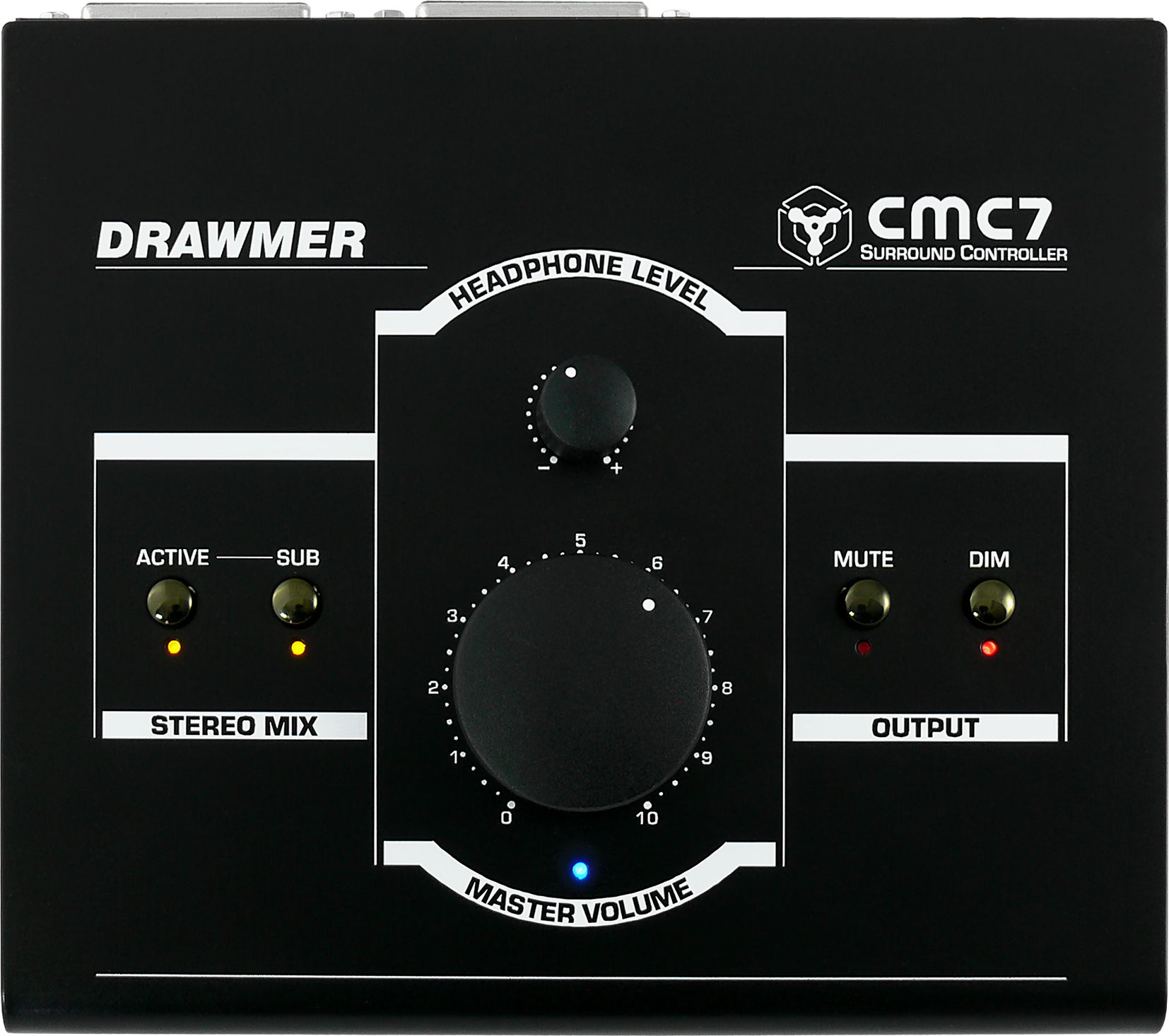
The CMC7 is a compact 8 channel / 7.1 / 5.1 surround volume controller and cost-effective alternative to the more complex and feature rich MC7.1. In order to maintain it's compact proportions and to keep the product budget friendly the CMC7 does away with controls that can often be found within workstation software and concentrates on essential features such as ease of use and the quality of the signal path, ensuring that the audio is transparent and accurate across all channels and operation intuitive.
Whether it is producing audio for film or television, or transporting the listener directly into the venue of an all-encompassing orchestral piece, one thing is sure, the number of users that wish to listen to audio within a surround setting has been growing and will continue to do so. The budget friendly CMC7 allows you to do this without the large financial outlay that other setups will produce.
Accurate & Transparent
Coming from the same stable as the MC2.1, MC3.1 and MC7.1 the the CMC7 Surround Monitor Controller provides the same high quality. The circuit is just as transparent and accurate. It's controls have the same quality feel and operation and the huge volume knob provides excellent channel matching, and smooth feel.
For all Drawmer monitor controllers it is imperative that what you record is exactly what you hear. The active circuit has been designed to faithfully produce the audio signal whilst removing many of the problems that a passive circuit will bring. There is one thing that should always be absolutely guaranteed - that you can rely on the accuracy of your monitor controller.
Surround Sound
The 8 inputs and outputs are provided via two balanced 25 pin d-sub connectors wired to the Tascam standard making connecting easy. It allows for 8 independent channels, 5.1, 7.1, quadraphonic, DTS®, Dolby Digital EX,THX Surround EX™, DTS-HD™, Dolby Atmos®, etc, the setup is up to the user.
With the Stereo Mix switch active the surround mix can be bounced down to a 2.1 signal in the front left and right monitors and sub-woofer, to test the quality of the recording when in stereo. In addition, it has a professional quality stereo headphone output with a separate amplifier and level control, that provides private mix checking, a DIM switch reduces output by 20dB and a MUTE switch is also available to cut the output completely.
Precision
The circuit design of the CMC7 ensures that the channel matching of all 8 channels is consistent throughout the full range of the volume control. Other manufaturers of surround controllers use multi-ganged potentiometers to achieve the levels of the 8 channels, this is especially true of passive surround controllers, this simplifies the circuit but leads to discrepancies in the level of each channel, especially at the lower and upper volumes, where accurate channel matching can vary wildly.
Compact
The CMC7 packs a lot of features into a small package. With a footprint of just 18x16cm and a very low profile the CMC7 it fits on every desk and is small enough to pop into a bag to take it anywhere.
Tough & Secure
Whilst being smart and stylish the rugged, all steel enclosure will withstand the knocks and bumps of the studio, and, coupled with the high quality components used, the CMC7 is built to last. In addition, a Kensington security slot provides protection from thieves.
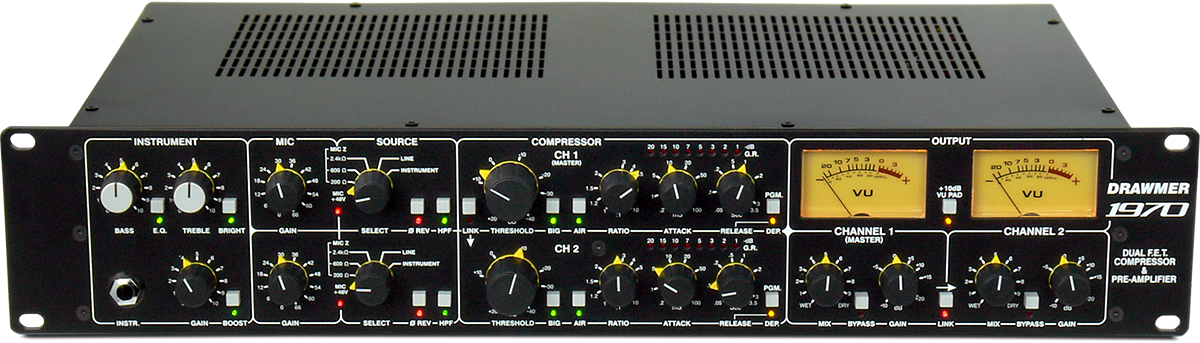
With a heritage inspired by the first pro audio "tool box" compressor, the illustrious Drawmer 1960, but with a greatly expanded feature set, the 1970 Dual F.E.T. Compressor and Pre-Amplifier is one of the most adaptable mic preamplifier/compressors on the market today, bringing vintage audio characteristics at an affordable price.
Whilst the feature set of the 1970 is similar to the Drawmer 1960, and the layout of the controls will add to the comparisons, the 1970 has been greatly improved and the EQ has been fine tuned to be more accurate than its stable-mate, with various improvements
The 1970 use the latest THAT Corporation technology in the 2 mic preamps to provide ultra clean, transparent and precise recordings that can be processed at a later stage using your favourite warming method, be it saturation, valve, transformer or tape. In addition each channel is capable of 66dB of gain, with switchable mic impedance for accurate mic matching to bring out the best from any microphone used. Phase reverse is also included.
From tracking instruments via the dedicated D.I. input, to recording vocals via the ultra clean mic pre's, recording a guitar cabinet with two microphones, or a singer playing guitar, or even stereo buss compression using the comprehensive linking and mix facilities, the 1970 is the perfect versatile tool for any studio or live event.
The introduction of the Drawmer DL241 Dual Channel 'Auto-Compressor' highlights the beginning of a new generation of dynamic processors which set new standards of sonic excellence. Its combination of features, displays and well designed control functions make it an outstanding product for a vast range of broadcast, sound reinforcement, and recording applications. The DL241 'Auto-Compressor' incorporates many automatic functions allowing the engineer to achieve optimum results in the minimum set up time but does not compromise skilled users with limited controls. Its sophisticated design produces a smooth, transparent and warm sonic performance.
Sound System Protection in 2 easy steps... Step 1: Insert key to 'unlock' front panel and adjust VU meter pre-set until the peaks of the incoming audio illuminate the red endstop 0dB LEDs. Step 2: Adjust max output level pre-set until sound system volume reaches the maximum permitted SPL as specified by the installer or client. Remove key... and sleep soundly.
The Drawmer SP2120 Speaker Protector offers both strict level control and tremendous peace of mind to the contractor, installer and venue in the knowledge that only the maintenance engineer and the venue manager hold a key. As its name suggests the 1U, two channel processor eliminates the possibility of 'unauthorised' excessive sound pressure levels on speaker systems which could result in damage to both chassis drivers and amplifier electronics. The unit also gives a wide variety of venues, such as clubs, theatres, pubs, schools, universities etc. the opportunity to comply with the local legislation regarding noise levels.
The SP2120 greatly benefits from Drawmer’s 25 years experience in designing industry standard dynamic processing devices. Its signal path combines a mixture of ‘multiple time constant’ circuitry and automatic gain control (AGC) which allow small overloads to sound louder - even though they’re not. Its concept and development was encouraged by Drawmer distributors and installers dissatisfied with other protection systems currently available. These often take the form of a crude switch, either turning off the power or disconnecting the speakers, both of which are ‘disruptive’ in any event. The SP2120 is intended to be inserted in the sound system immediately prior to the amplifier stage.
The vintage-style fully stereo 1974 four band Parametric Equaliser provides exceptional analogue musicality and sonic clarity, taking it's inspiration from 1970's-era gear. It has the ability to perform subtle shaping for mastering purposes that require a delicate touch and easy recall, but is just as capable of tonal sculpting, adding the analogue warmth and character that is near impossible to emulate in the digital domain.
Get immersive with the stereo operation, with one set of controls for both channels. The versatile design features dual channel precision stepped potentiometers, providing exceptional accuracy for fast and simple recall. The fully variable bandwidth allows you to control the parametric mid bands, making adjustments as surgically precise or as broad and natural sounding as you could ever require. Fully adjustable low and high cut filters are also included, ideal for tuning out undesirable signals at the frequency extremes. It also features a switchable slope allowing you to alter the focus at the high and low frequencies plus a low peak setting that magnifies the bottom end. The 1974 is perfect for tonal shaping, staying true to the sound of the 70s and ideal for any musician.
Genuine Stereo Operation with Indented and Accurate Potentiometers
The genuine stereo linked operation of the 1974 makes adjustment quick and extremely simple using just one set of controls to alter both channels. The 1974 uses precision potentiometers, each one being matched for left/right accuracy to within fine tolerances by our trained technicians, so that both channels operate identically, and also have indented operation, providing exceptional accuracy for fast and simple recall.
Fully Parametric with Totally Variable Bandwidth
The 1974 is a true 'parametric' equaliser, with the four bands having fully variable frequency controls and offer cut and boost of +/-12dB's. However, unlike EQ's with a no bandwidth adjustment, or a simple switch, the two mid bands have completely variable filter bandwidth controls enabling the user to focus in on very narrow sections of the audio spectrum or apply a broad natural sounding filter, or, of course, anything in between the two. This makes the 1974 incredibly versatile and capable of modifying everything from subtly fine tuning mixes to tone sculpting problematic recordings.
Variable Low and High Cut Filters
The 1974 also includes fully variable low and high cut filters, ideal for tuning out undesirable signals. The low cut (otherwise known as High Pass Filter) having a range of 10Hz-225Hz and the high cut (otherwise known as Low Pass Filter) 4kHz-32kHz. The beauty of being fully variable is that, unlike fixed frequency filters, it is easy to sweep both controls to find the perfect setting and remove sounds with pinpoint accuracy.
Switchable Slope Setting
Very few analogue parametric equalisers have an adjustable slope on the low and high bands. The filter slopes of the 1974 have been chosen for their musicality. At the bottom end slopes of 6, 9 and 12dB per octave plus a Peak setting are available, and at the high end 6 and 12dB's per octave. The Peak setting is quite a unique feature in that it adds a narrow bell shape to the 12dB per octave low cut filter at the knee frequency just before it rolls off.
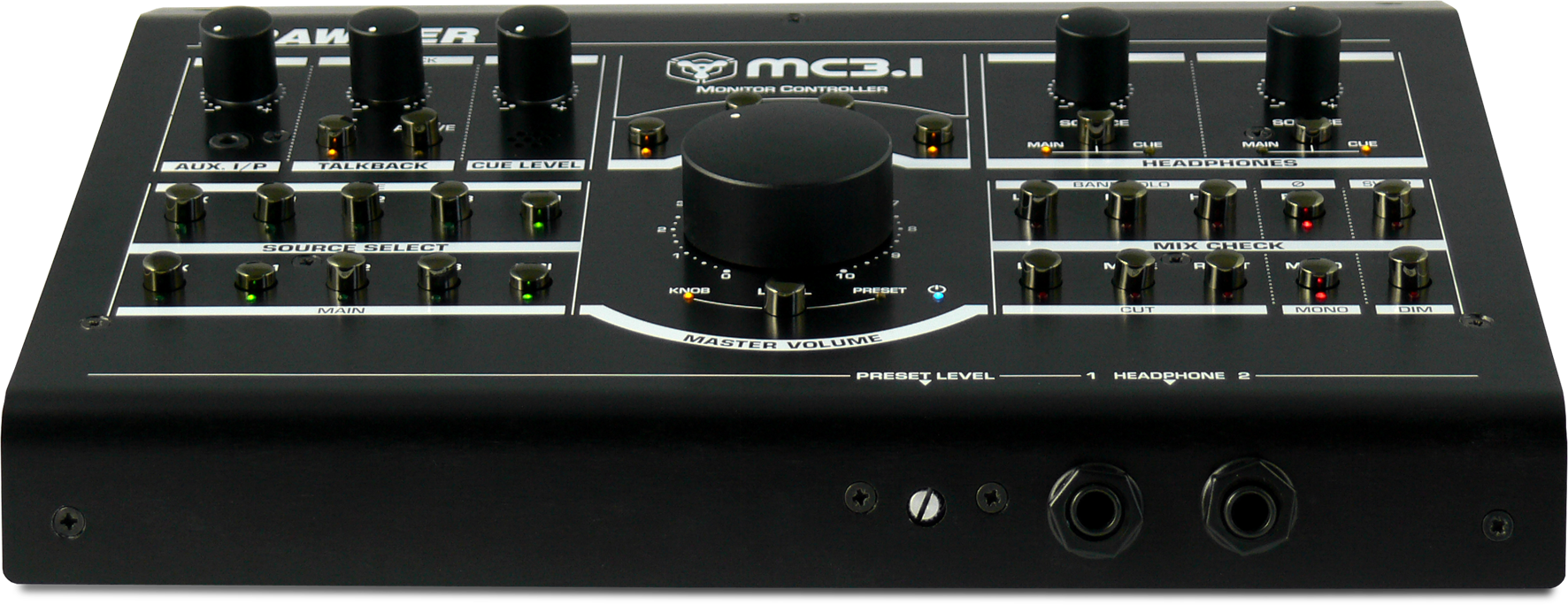
The MC3.1 is an accurate and transparent and quality build Monitor Controller for faithfull reproduction what has been recorded without colouring the sound. It is build on the the success of the MC2.1 Monitor Controllers with an expanded feature set, including more inputs, better control, extended channel routing and a desk top 'wedge' form factor.
MC3.1 provides a total of 5 individually switchable sources, including a front panel auxilary input with level control for the easy connection of a mp3 player, smartphone or tablet and a combined digital AES/SPDIF (24 bit/192kHz) input. Full cue mix facilities, with level control, offer separate source selection for main or cue outputs and the two headphone amplifiers, so the artist can listen to a completely different mix than the engineer, for example. A dedicated cue mix output is also available.
The secondary preset volume control on the front provides repeatable calibrated output level for the monitors, so that at the flick of a switch the engineer can hear the mix at the same predetermined volume, time after time, without having to meticulously adjust controls.
The MC3.1 incorporates three stereo balanced speaker outputs, plus a dedicated mono speaker/sub-woofer output each with individual left/right trims under the unit to provide complete control over level matching. Furthermore each can be switched individually and simultaneously and in any order. Multiple speakers can be used with the same sub-woofer or without the subwoofer.
For additional mix checking capabilities the MC3.1 incorporates low, mid, high solo switches to hear how the lows bleed into the mid, or the stereo width of each, for example, and also the ability to swap the left and right channels. The talkback section includes an external mic input in addition to the internal mic, and can be controled via footswitch.
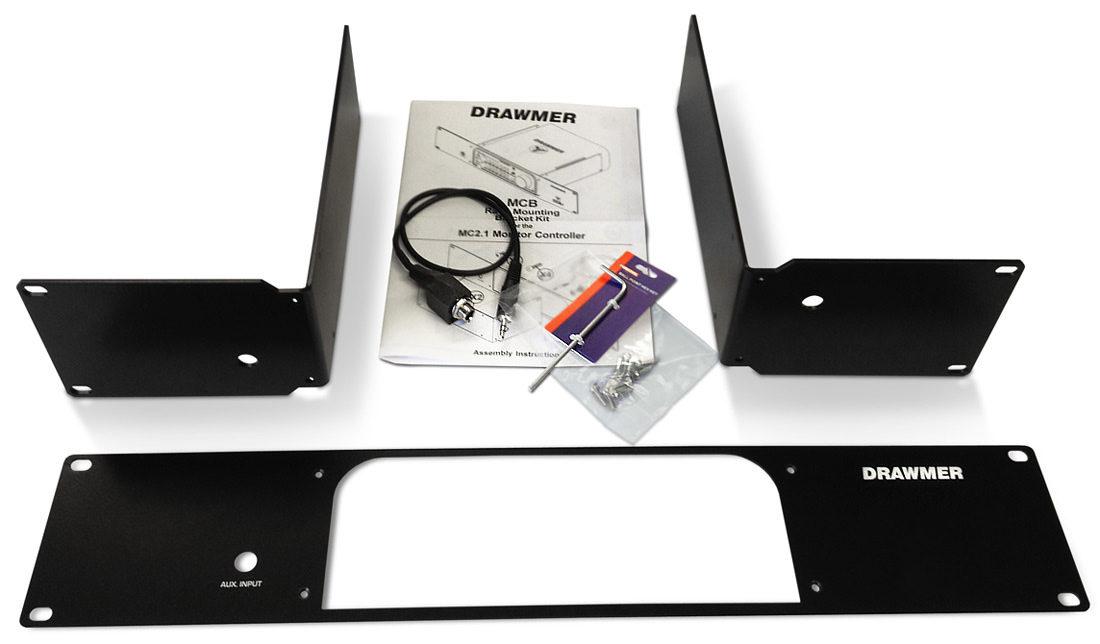
The MC-Rack Mounting Kit contains two side panels/ears, a front facia, and also a lead that brings the AUX input from the back of the MC2.1/MC1.1 to the front panel for easy access. Also included are the necessary screws, an assembly instruction manual and even an allen key.
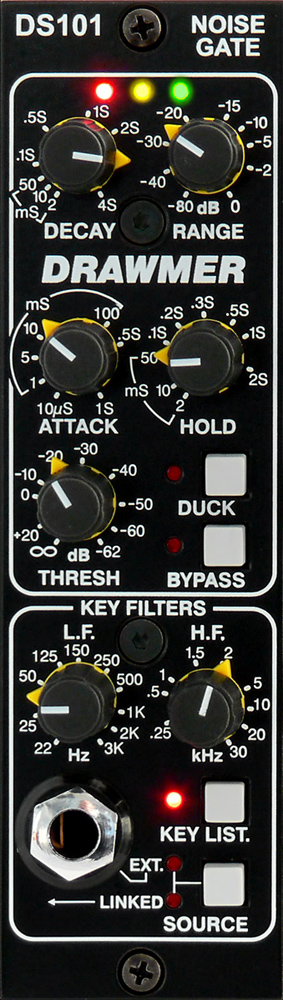
The Industry-Standard High-End Noise-Gate comes to the 500 Series!
The DS101 is the first noise gate designed specifically for the 500 Series rack system and takes its place alongside the Drawmer family of industry standard Noise Gates, such as the DS201, DS501 and DS404. Anyone familiar with those units will immediately be at home with the DS101.
Based on a single-channel of the DS201 the DS101 is a sophisticated noise gate incorporating a number of features pioneered by Drawmer, which are invaluable to the sound engineer, such as variable high and lowpass filters for “frequency conscious gating.”
Other features include comprehensive envelope control, attack, hold, decay, and range, plus a whole host of other features, all adding up to one amazing processor.
When placed side by side in a 500 series rack two or more gates can be linked using the new infra red triggering mechanism employed on the DS101. This means that any number of gates can be linked with each having their own envelope shaping whilst the trigger pulse passes through unchanged, this opens up a whole world of “envelope follower” effects limited only by your imagination.